
The Pleasanton Unified School District has long been known for its diverse array of educational programs. From Outdoor Ed to science, to fifth grade music ensembles and PE classes, the opportunities are numerous. However, after the Feb. 19 PUSD School Board meeting, these programs — among other established teacher positions — have been on the chopping block.
The Cuts’ Effects
The district needs to meet fiscal solvency, or stability. It must be able to meet its long-term financial obligations in order to stay financially consistent. To fulfill this goal, approximately 16.2 million dollars need to be cut from the budget. With 11 million already approved, up for negotiation is the remaining 5 million.
“We look at the cuts and it’s a series of cuts that really are affecting our most vulnerable students. [They affect] their mental health, or their access to education, or the quality of their education. Our main goal is that we can find a way to make sure to limit the cuts and the damage as much as possible, while still maintaining a contract that defends our members and makes sure that we can attract and retain quality educators,” said Association of Pleasanton Teachers (APT) president Evan Branning.
Repercussions on Students
On the chopping block are critical staff positions, such as program specialists, counselors, and attendance and library administrators. In doing so, many students will not recieve necessary accomodation and schools will grow increasingly shortstaffed.
“I worry about the emotional and mental health support, and that obviously is our highest priority. [I] want to make sure that students have access to us in their time of need. We are put in a position where we’re more reactive and don’t have the ability to be proactive with students. Counselors here have written over 500 letters of recommendation for college as well as letters for other programs. I also worry about our graduation rates going down, and students not being able to get support,” said head school counselor Sheryl Pacheco.
For the last couple of years, the school board has approved numerous budget cuts against counselors, negatively impacting both students and staff. Many depend on counselor support, and without the funds, many are at a disadvantage.
“I was concerned about the proposed counselor cuts that were voted on and unfortunately approved in the meeting. I worry about [the cuts] impact on our students, and I wanted to make sure that the counselor’s voices were heard. The students need their counselors, and so I just wanted to advocate for us on behalf of our students, because I know that the less of us there are, the less help that students are going to be able to have access to,” said Pacheco.
Budget Cuts: From Elementary Schools to High Schools
The counseling staff does not stand alone, however. Students at Amador also recognize the amazing work the staff does to help them throughout high school, whether it’s finding a safe space to talk or receiving a recommendation letter.
“This is the one period of time in people’s lives where [school] could either make or break your future. Taking helpful resources like [counseling] would be really negative for students. They won’t have an outlet if they have problems at home, or if they’re facing any problems at school. I don’t know what they would do without [counselors],” said Arthreya Suresh (‘26).
Elementary school students also reap the benefits of PUSD programs. In primary schools, the science, physical education, and music programs are all facing removal. To many, including Amador chemistry teacher Frances Acosta, cutting these elementary programs would leave a negative impact on current elementary students and their futures in middle and high school.
“[Program cuts] will negatively affect students… because [the students] are not going to have that confidence going into from elementary, into middle and high school. Science is interdisciplinary. You need math, reading skills, and explanation skills. Students may not learn those skills if science is missing,” said Acosta.
As the concern of losing crucial programs rises, the question of learning experiences and opportunities created by these programs continues to grow. Advocates of these programs argue that students may have not discovered their interests without the help of those stimulating programs stemming from childhood.
“We had a big music program [in elementary school]. I used to play the piano. They would give you coaching for that instrument. We also had a really big P.E. program where they had coaches come in that would train us. Music is still a big part of my life and I never would have started soccer if I didn’t play it in P.E.,” said Suresh.
Community Effort: How Students Can Contribute
As organizations such as APT work to reduce the budget cuts, students are encouraged to participate as well. These cuts directly affect the students’ learning, and students drive change once they speak up about their personal experiences.
“Students can definitely go to district office meetings and speak out. Especially about experiences like how you felt and how that is or has affected your learning. So the board isn’t hearing just from us teachers,” said Acosta.
Teachers’ jobs and school programs, among others, are still at risk as cuts continue to be voted on. It is imperative to spread awareness throughout the community.
“Getting the word out to the community and letting them know about the cuts is very helpful; letting the community know the impact that it would have on students. We’re all here for the students, and so those are the voices that I think are the most important. If students have concerns of the impact that it will have on them, they need to express that,” said Pacheco.
APT: Student and Teacher Advocacy
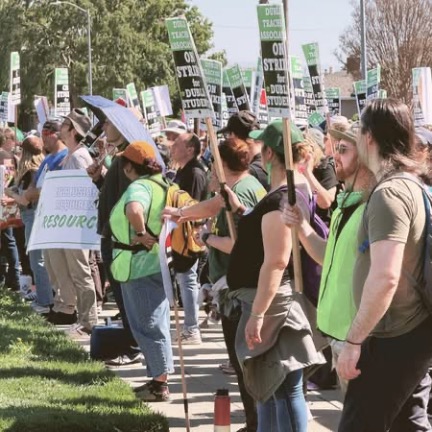
APT, or the Association of Pleasanton Teachers, is a coalition that advocates for PUSD teachers, specialists, and counselors. When prospective budget cuts such as those made on Feb. 19 are on the horizon, members often show up at board meetings in large numbers. Armed with orange signs, some choose to remain silent, though others speak at the podium.
“By showing up, it’s about making sure [the Board] understands that we are there to stand in solidarity with each other. [We make sure they understand] that every unit member is valuable, that we all got into education to serve our students, and that we’re willing to do what it takes to protect them and so that they can get the education they deserve,” said Branning.
As for students, Branning reiterates the importance of speaking out — especially for students. By showing up at board meetings, students can emphasize APT’s values of serving the community.
“I don’t think I can make it clear how impactful it is when a student talks at a board meeting. Not a lot of students will come out and…we don’t often see young people coming out and speaking for something. It is actually extra impactful when someone does,” said Branning.