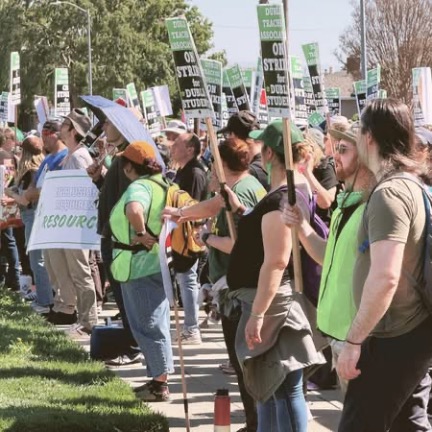
From Monday, March 12, to late Thursday evening, March 15, Dublin Unified School District (DUSD) teachers, counselors, and specialists lined school borders from dawn to dusk, holding picket signs and chanting at passerbys. After four days, the outcome was unprecedented — the District agreed to the Dublin Teachers Association’s terms, retaining school counselors, a cost of living raise, improved healthcare, and smaller class sizes.
“Collectively, our teachers and all of our specialists felt that it was necessary [to strike], due to the fact that the District was not providing fair and reasonable adjustments to class sizes, to caseloads for our special education, and for teachers and our district specialists,” said DUSD speech pathologist Lacey Meyers.
Both the strike and its outcome served as milestones for the District. For the first time in fifty years, teachers were striking, their classrooms empty and the school sidewalks filled instead. Despite receiving no salary for the strike’s duration, many accepted this sacrifice for a better outcome.
“It was a slow and long (approximately 7 months) build up of frustration and lack of compromise from the District management that really forced and motivated us as a union to come together in order to have our concerns heard and recognized. To strike,” said an anonymous DUSD elementary school teacher.
The Grievances
Dublin, much like its neighboring city of Pleasanton, has seen no shortage of severe budget deficits in recent years. As the budget tightens, the District almost always places certain positions, programs, and for teachers, benefits on the chopping block. In order to save money, the District plans to remove school counselors, sparking discourse — and a strike.
“[Counselors] at the elementary school level teach kids a lot of skills that they will take and use for the rest of their lives. We work on things like coping strategies, social skills, [and]…what healthy relationships look like. We are there in case of a crisis…sometimes kids just need a little extra help, and when you remove counselors, you remove their access to that help,” said an anonymous DUSD union member.
Additionally, reflecting a broader trend in budget preservation, the District planned to increase class sizes in order to save money. This decision drew backlash from the teacher community, as many advocate for smaller class sizes that bring tailored instruction to students.
“People move to cities [like Dublin] because they’re expecting to send their kids to really good, high-quality schools. When you make class sizes too big or when you give [teachers] caseloads that are too much to handle, the kids’ learning suffers,” said the union member.
Students’ rights were not the only ones at the heart of the strike. Teachers who do not receive the support they need oftentimes are unable to relay that support to their students. For Dublin, this support comes in the form of healthcare benefits and a cost of living adjustment (COLA), or a raise.
“We were actually just asking for a 3.5% increase in salary. The District was initially offering 0%, so they were not willing to give us any type of compensation. They ended up coming back with a counter of a 2.1% raise, [but] the cost of living raise is actually more than that, so it didn’t even cover the [raise],” said Meyers.
Cost Contention
The District’s willingness to comply with financial proposals was a subject of controversy throughout the strike. Despite consistent negotiations between the DTA and the District, there were still significant discrepancies between the union’s requests and Dublin’s offers. For many teachers who are reliant on healthcare benefits for their families, these discrepancies often mean partial, unsustainable coverage.
“As far as healthcare, we were looking for [complete] coverage for a single employee, 90% coverage for a two-party family, and then an entire family to be covered at 80%. The District was not willing to negotiate anything regarding 100% coverage, so they were offering 85% coverage for a single party. They would not get us to 100% coverage for another two years — so as of January 2028 — and… it would just be for a single person,” said Meyers.
Though peaceful, the strike did hold aspects of retaliation against the District’s practices. In question was the District’s method of approaching agreement negotiations and handling students in wake of the strike.
“A really large piece of contention within the school district [is how] our school district — more than any other neighboring school district — spends an insane amount on consultants when they could be providing that money back into the District. $12 million, I think, is their budget for consultants in the upcoming year, and we were asking for them to re-prioritize their money and cut $3 million of that to put back into the budget for students and for teachers, and they refused to do that,” said Meyers.
Moreover, as classrooms remained empty, substitute teachers were invited to restore some semblance of a learning environment to the schools. In their search to find temporary teachers, the District began to offer salaries that were over double the regular wages of a substitute on an ordinary day — further agitating the union.
“They were offering substitutes $500 to come and cross the picket line and sit in as substitute teachers. After the first day of the strike, they actually raised that amount to $600 a day. Just for perspective, I think an average day’s substitute pay is typically around $225. [They were] claiming that they don’t have the money to pay us or to reach a deal, but yet they’re offering people $500 to cross,” said Meyers.
Support on the Streets
With the District’s salary-increased offer to substitutes, many staff members were disappointed to find many retired administrators crossing the picket line. The more people that cross the picket line, the longer the strike goes on. And for teachers, that means more days without pay. However, support remained on both sides of the spectrum.
“97% of certificated staff did not cross the picket line. We have two different unions and so we had many many of our classified staff [participating]. These would be our instructional assistance, secretaries, and health clerks… and they did not cross the picket line so they too stood with us…in solidarity,” said Meyers.
Although most students ended up staying home as the strike ran its course, many of them decided to go out and show support for their teachers.
“My students are so young I think there is so much confusion for them. Many have come to hug me, bring me coffee and treats, and send their love while I walk the picket line. Many of the high school and middle school kids have made their own signs and joined us on the picket line. Some even brought us cookies,” said the DUSD elementary school teacher.
Success and Impact
After four days of strikes, the DTA and the District reached an agreement. However, this outcome did not come without a cost.
“[During] the back-and-forth and bargaining, we have had to concede a lot more as a teachers association and as teachers because of the District’s unwillingness to really meet us in the middle. Ultimately the board and the board president have the ability to,” said Meyers.
Furthermore, repeated attempts at bargaining were extensive, some even extending into the early hours of the morning. Both agreed upon a 2.3% pay increase, decrease in class sizes, and increased “single premium” healthcare starting from 2026.
“It came down to what was best for the students, and even though salary and benefits are something that is worked on in bargaining, that was not the main focus of our bargaining arrangement, and parents know that. Parents actually support the fact that we should have a cost-of-living increase, because we live in an expensive part of the Bay Area,” said Meyers.
Ultimately, the students were at the heart of the strike’s goals. As teachers returned to their classrooms the following week, not only had they changed their own stakes, they changed those of the students as well.
“[Striking] shows kids that you should stand up and fight for the things and the people that you believe in and that you care for. As educators, we do our jobs because we love our kids and our students. If I care about them and their learning, I want them to be in a small class where the teacher has the time to give them the attention that their learning deserves,” said the anonymous union member.