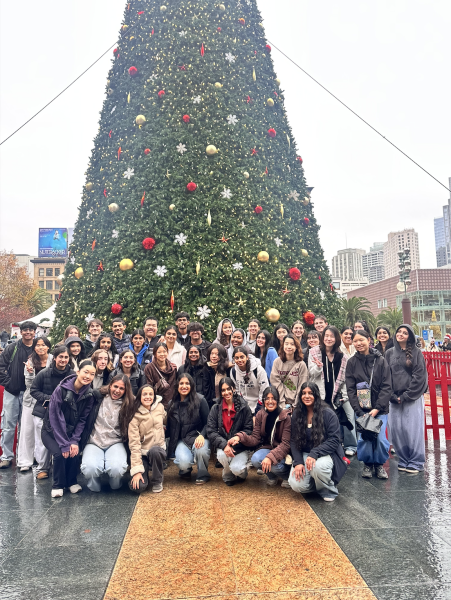
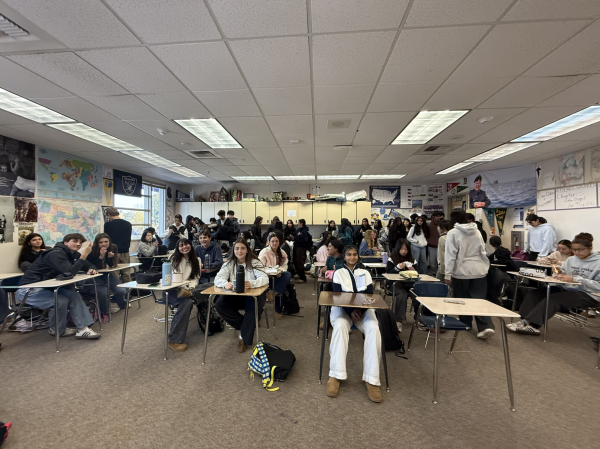
December 20th—a cold, rainy morning on Winter Break. While most students were at home sleeping in, Amador Valley’s Red Cross club took the 8 a.m. BART to San Francisco for their annual Socks in the City trip, handing out goods and necessities to the homeless.
The Mission of Red Cross
Founded with the intention to help neighbors with humanitarian need, the program provides help to people in need across the Bay Area.
“The Red Cross club at Amador is created to try and extend the mission of the American Red Cross and also the international Red Cross. This entails allowing high schoolers to have the opportunity to volunteer with the Red Cross and learn about things like disaster preparedness, and helping with international humanitarian relations,” Zara Nesar (’26) said, President of Amador Valley’s Red Cross Chapter.
The International Red Cross and Red Crescent (ICRC) network is the largest humanitarian network in the world, with a presence in almost every country.
Planning Socks in the City
While only lasting a day, trips like this have a lasting effect—thus, they take months of planning ahead.
“A few months before Socks in the City, we have to start planning out all the different aspects that go into it. There are things like getting donations from our members, getting blankets, making sure everyone signs up to get food and toiletries, or getting other things like First-Aid kits,” Nesar said.
To ensure the trip’s success, club leaders put great effort into making sure people attend for the sake of helping others.
“We also have an application process where people can say how long they’ve been a Red Cross member for, and why they want to go on the trip. This makes sure that we’re giving this opportunity to the people who really want to extend upon this and help the San Francisco community,” Nesar said.
All Red Cross activities have one purpose: helping those who suffer without any judment. The Amador valley officers help to achieve this goal through events like Socks in the City.
Why Students Join
While there are many community service organizations on campus, some students prefer the direct-action approach offered by Red Cross.
“I joined Socks in the City because it felt like an opportunity where I could directly help my community and make a change that wasn’t just indirect, like making cards for people or just putting positive words out there. I thought it was a good [chance] to actually help make a change, and feel like I’m doing something rather than just sitting around watching harm happen in the world,” Sophie Lashkarian (’28) said, Red Cross Member.
This trip is taken every year by the Red Cross group, allowing students to make a real life impact on others lives.
“We do the socks in the city every single year, but every year, our mission is to make ure that there’s never a year less impactful than the last,” Nesar said.
Challenges on the Trip
Although there was plenty of planning prior to the trip, missions like this do not come without challenge.
“I think an issue that was really prevalent when we went on the trip was the fact that it was hard to find homeless people in the beginning. This is partly because San Francisco is doing its part in making sure that there aren’t congregations of homeless people on every single street. So we found that most of the streets, like the main ones coming out of Civic Center, or even the areas heavily populated by restaurants and businesses, were harder to find [homeless] people,” Nesar said.
In 2025, the city of San Fransisco issued a plan that focused on permanent housing exits and stronger outreach, causing San Francisco to see its fewest street tents since the pandemic. Still, Red Cross members were dedicated in their mission to provide basic necessities for all.
“We had to overcome by finding a balance between staying in areas that were more populated by people and that were safer for us to go to, or taking a little bit more of a risk and going to sketchier places, but being able to give up these supplies and actually finding homeless people,” Nesar said.
Misconceptions and Lessons Learned
The trip was also a learning opportunity for many, helping them evaluate and address some prejudices they may hold
“Even though people might feel like homeless people are aggressive, or they might all be drug addicts, or treat them as less than human, I learned that it’s truly not like that…of course, they all have struggles, and at the end, they were so grateful for everything that we gave them,” Lashkarian said.
“[On the trip], we talked to some of them. They were so grateful for everything, and some would tell us [stories about their lives]. Sometimes, people overlook their existence and humanity. [Socks in the City] put a new perspective on everything,” Lashkarian said.
Many people think that homelessness is a choice, but it’s usually the result of larger systematic issues.
“It was really good to feel like you were putting yourself in another person’s shoes, because a lot of times you just walk past homeless people and you really don’t put a second thought into it, or you might feel bad but there’s nothing you can really do at the moment,” Lashkarian said, “[Socks in the city] taught me to be more present in the moment and to not worry so much about little issues when there’s so many other worse things that can be happening.”