
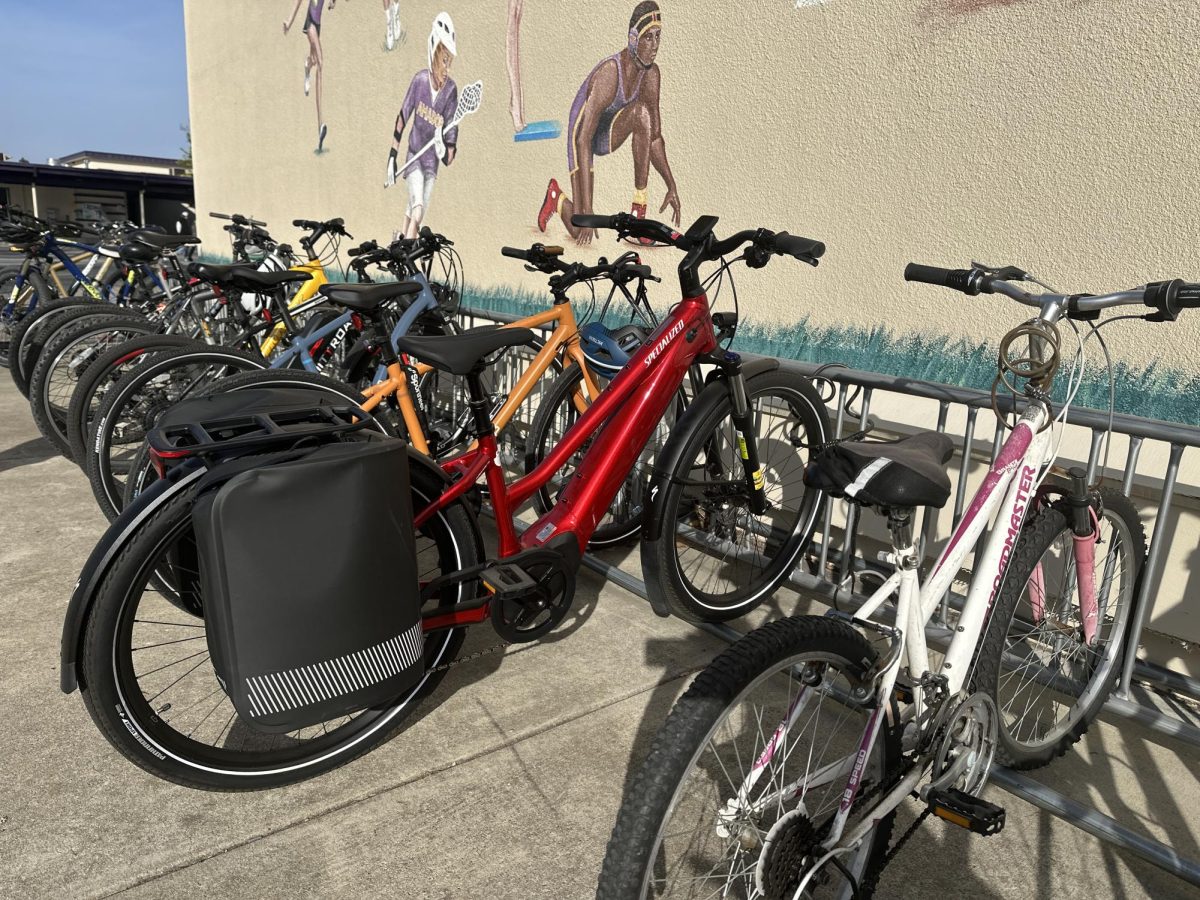
The smooth motor, speedy travel time, and reduced fuel consumption of an e-bike are enticing. However, as e-bike use steadily increases, concerns about their safety risks have become more apparent.
“When you’ve got an e-bike on the road or on the sidewalks, and you’re flying on the sidewalks, that is certainly a situation that’s quite dangerous,” said Pleasanton resident and e-bike owner Roger Lewis.
E-bikes enable riders to reach faster speeds, cover longer distances, and use less energy. An e-bike contains an electric motor and a battery that provides assistance.
“I have an [electric] mountain bike, which allows me to ride at the Pleasanton Ridge, and I might be able to ride seven to 10 miles with a regular bike. [With an e-bike] I can ride 15 to 20 with the same conditioning that I’m in,” said Lewis.
Three Classes of E-Bikes
E-bikes come in three different classes. Class 1 and Class 2 e-bikes both contain pedal assist, while Class 2 e-bikes contain a throttle. Both Class 1 and Class 2 e-bikes reach a maximum speed of 20 miles per hour.
“The [e-bike] I have is pedal assist, so it gives you a little bit of a boost when you ride it,” said English teacher John Benbenek.
Class 3 e-bikes are the most powerful of the three, reaching a maximum speed of 28 miles per hour. They typically aren’t allowed in parks or paths.
“There are some [e-bikes] that have throttles. So you don’t have to pedal. I don’t know if there’s a lot of advantage to that one. You might as well get a motorcycle,” said Benbenek.
Hidden Risks of Higher Speeds
On the surface, e-bikes and regular bikes look similar. Casual cyclists typically ride at 12-14 mph, with higher speeds requiring more experience. E-bikes allow inexperienced riders to easily reach higher speeds.
“You also have to calculate [your speed] because it’s gonna take longer to break…you just have to have some common sense about how fast you’re going, and basically how much load you’re carrying as you’re going,” said Benbenek.
The higher speeds that e-bikes provide can be disadvantageous. The speed reduces riders’ reaction time and increases the risk of collisions. As a result, e-bike riders are more likely to sustain serious injuries, including internal injuries and concussions. However, their attractive designs and bicycle-like appearance keep these risks hidden from younger riders.
“I have thought of getting an e-bike, but I hesitated to buy it due to it being a bit too expensive and safety concerns with high speed in traffic. There’s also just a lot of unpredictability. I can comfortably go on as fast as I want with a regular bike, but with an e-bike it’s much more uncertain,” said Srikar Kurakula (‘29).
Growing Threat to Riders and Pedestrians
E-bike riders often share the road with motor vehicles rather than using dedicated bike lanes. Because they lack physical protection, they are especially vulnerable and face a higher risk of fatal injury in the event of a collision. When riding on sidewalks, e-bike riders are three times more likely to crash with a pedestrian compared to a traditional bike.
“[E-bikes are] fairly heavy. So if you’re going at a brisk pace, and you’ve got a heavy bike moving at a good speed, if you run into somebody, they’re gonna feel the impact. It’s a lot more of a problem than just riding a regular bike,” said Benbenek.
In 2024, U.S. researchers reported a 49-fold increase in head trauma among e-bike riders, attributing this rise to insufficient regulations, such as the absence of mandatory helmet use or speed limits. While California requires e-bike riders to wear a helmet regardless of age and be 16 or older to ride a Class 3 e-bike, the high potential for e-bike-related injuries calls for broader awareness.